The Balvenie in Dufftown: Glenfiddich's neighbour, five crafts at the distillery and a honeyed style
Glenfiddich's neighbour since 1892
The Balvenie is a single malt distillery located in Dufftown, in the heart of Speyside. William Grant built it in 1892 on the land next to his first distillery, Glenfiddich, and the first spirit flowed from its still in 1893. Both distilleries still belong to William Grant & Sons, a family-owned group that has remained independent. Same owner, same village: yet it is the production choices that make The Balvenie a whisky apart.
Five crafts kept on site
The distillery calls them its "five rare crafts": barley grown on the neighbouring Balvenie Mains farm, floor malting, the coppersmith, the cooperage and the malt master. Most Scottish distilleries buy their malt from industrial maltings. In Dufftown, part of the barley still germinates on malting floors in use since around 1931, turned by hand before being dried in the kiln. The coopers repair and rebuild casks on site, while the coppersmith looks after the stills.
A honeyed style, built on American oak
The distillery champions one common thread, honey, which can be found from one bottle to the next. It originates in the first maturation: before any finishing, the whiskies of The Balvenie range are aged in American oak casks that previously held bourbon, which lend vanilla and malty sweetness. All of them are single malts, that is, whiskies made solely from malted barley at a single distillery. The house malt is dried over anthracite with a hint of peat, far too little to produce a smoky whisky.
DoubleWood, Caribbean Cask, Pineau, PortWood: a broad range from The Balvenie
DoubleWood 12 Years Old, the gateway
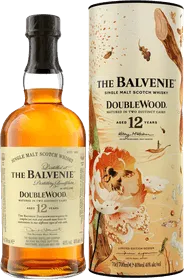
DoubleWood 12 Years Old, the distillery's benchmark single malt, illustrates the principle that sets the bottles of the range apart: a second cask is added to the American oak foundation. After at least twelve years in ex-bourbon casks, it spends nine months in Spanish oak that previously held oloroso sherry, then three to four months in tuns, large wooden vats where the casks are married before bottling. The edition illustrated by the artist Victo Ngai dresses this same whisky in a collector's gift box.
Caribbean Cask 14 Years Old, a detour via rum
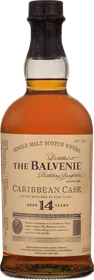
Caribbean Cask 14 Years Old completes its maturation in American oak casks that the malt master had first filled with his own blend of Caribbean rums. Once the wood was deemed ready, the rum made way for the whisky. What remains is butterscotch, vanilla and exotic fruit. Added to the permanent range in 2013, it is the choice of an enthusiast who prefers roundness to the dry character of sherry.
Two whiskies refined in Pineau des Charentes
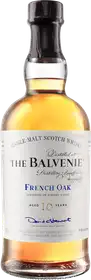
French Oak 16 Years Old, launched in 2022, is the distillery's first finish in French oak. Its casks previously held Pineau des Charentes, a fortified wine made by adding cognac to unfermented grape must. Bottled at 47.6% without chill filtration, it plays on citrus, honey and ginger.
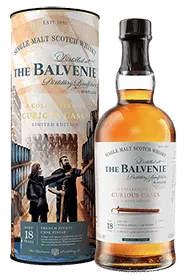
The 18 Years Old French Pineau Cask from the Curious Cask collection comes from the casks of David C. Stewart's very first experiment with Pineau: distilled in 2005, it is bottled cask by cask, at 47.9%. The 16 Years Old is a recurring recipe, the 18 Years Old a limited series in which each cask differs.
PortWood 21 and 25 Years Old, for slow sipping
PortWood 21 Years Old blends old whiskies from the distillery, then refines them in pipes, those port casks, aged around thirty years. It has existed since 1996. The 25 Years Old takes the opposite path. Where finishes add a second wood, it marries casks that have each matured separately, mainly ex-bourbon American oak and a share of European oak from sherry casks.
Reading the label on a bottle of The Balvenie: expression name, finish and malt master
What the expression name tells you
At The Balvenie, the name almost always refers to the finishing cask: DoubleWood for the two woods, Caribbean Cask for rum, PortWood for port, French Oak for the oak of Pineau casks. As with any Scotch whisky, the age statement indicates the youngest whisky in the bottle. Curious Cask denotes a series within the Stories range, devoted to unusual casks bottled one by one.
Finishing, a method developed in Dufftown
In 1982, David C. Stewart transferred twelve-year-old Balvenie into oloroso sherry casks for a few months. The experiment produced the Classic in 1983, renamed DoubleWood in 1993, and the method has since spread throughout Scotland. The duration is adjusted to the age of the whisky: nine months for the 12 Years Old, only three for the 2018 DoubleWood 25 Years Old, a whisky already rich in spice after a quarter of a century in cask.
From malt master David C. Stewart to Kelsey McKechnie
Having joined the distillery at the age of 17, David C. Stewart became its malt master in 1974 and held the role for nearly fifty years. Kelsey McKechnie, who joined William Grant & Sons in 2014, became his apprentice in 2018, shared the role from October 2022, and has held it alone since 2023. Both signatures may therefore appear on bottles of the range.