Moët & Chandon in Épernay: the vineyard, the dosage and the role of the cellar master
1,300 hectares, half of them grand cru
Moët & Chandon farms the largest vineyard in Champagne: 1,300 hectares, half of them classified grand cru and a quarter premier cru, according to LVMH. This extent gives the cellar master a range of grapes that few houses can draw on, and it is what allows the house, it says, to reproduce the same cuvée from one harvest to the next. Founded in 1743 by Claude Moët, the house ages its wines in Épernay, in cellars dug beneath the Avenue de Champagne, the most extensive in the region.
A dosage halved in twenty-five years
The house describes its style as one of vibrant fruit, a seductive palate and elegant maturity. The dosage, meaning the sugar added just after disgorgement, is its most visible lever. In 1998, the Brut Impérial received 13 to 14 grams per litre; it is now 7 g/l, and the Grand Vintage cuvées have been dosed at 5 g/l since the 2002 vintage. Benoît Gouez attributes this decrease to changing tastes as much as to the climate: riper grapes, picked earlier and less acidic, no longer need to be softened.
Benoît Gouez: consistency for the non-vintage brut, the year for the vintage cuvées
Having joined Moët & Chandon in 1998, Benoît Gouez has been its cellar master since 2005. Each autumn, he tastes 800 to 1,000 base wines before settling on the blend of the Brut Impérial. For the vintage cuvées, his rule is reversed: he looks less for the house style than for the truth of the year, so that even an atypical vintage finds its place in the series.
Brut, rosé or demi-sec: choosing among Moët & Chandon non-vintage champagnes
Brut Impérial, the starting point
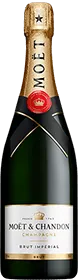
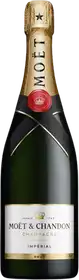
The first cuvée in which this pursuit of consistency comes into play, the Brut Impérial is Moët & Chandon's non-vintage brut, created in 1869. The three Champagne grape varieties are blended in almost equal parts (30 to 40% Pinot Noir, as much Meunier, 20 to 30% Chardonnay), complemented by 20 to 30% reserve wines from earlier harvests, which smooth out the differences between years. It is the most versatile cuvée in the range. For a first discovery at the table, Benoît Gouez recommends a fish with beurre blanc sauce.
Rosé Impérial, Pinot Noir in the foreground
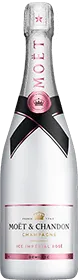
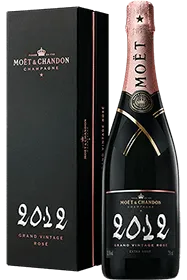
The Rosé Impérial follows the same construction, with the same 7 g/l dosage, but with 40 to 50% Pinot Noir and only 10 to 20% Chardonnay. Red fruit takes the lead, and the house suggests serving it with roast duck with raspberries. Moët & Chandon rosé champagnes also include a vintage cuvée, the Grand Vintage Rosé, and a demi-sec, the Ice Impérial Rosé.
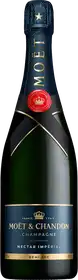
Ice Impérial and Nectar Impérial, the demi-secs
Launched in 2011, the Ice Impérial was, according to the house, the first champagne designed to be served over ice. It is dosed at 45 g/l, more than six times the Brut Impérial, a level chosen, according to Benoît Gouez, so that the wine keeps its balance in contact with the ice cubes. The Ice Impérial Rosé stops at 38 g/l. The Nectar Impérial has the same dosage as the Ice Impérial and takes its name, according to the house, from this generous sweetness.
Grand Vintage, Grand Vintage Collection, Collection Impériale: vintages and champagnes for cellaring
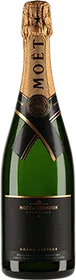
Grand Vintage, a year rather than a style
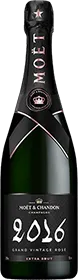
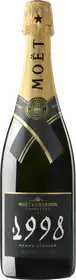
Where the non-vintage cuvées blur the year, Moët & Chandon's vintage champagnes showcase it. The Grand Vintage comes from the single harvest named on the label, in the years the cellar master chooses to declare. It rests for five to seven years on the lees depending on the vintage, under crown cap, and its 5 g/l dosage makes it an extra brut champagne. Its composition changes freely, so that no two vintage champagnes from the house are ever quite alike.
Grand Vintage Collection, the same wine disgorged later
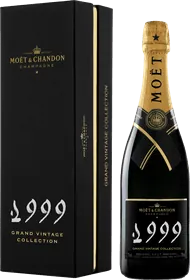
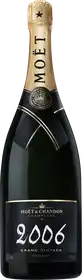
The Grand Vintage Collection is not a separate cuvée: it is a Grand Vintage that has already been released, part of whose bottles remained in the cellar under cork for a second disgorgement, after a minimum of fourteen years. The 2006 thus spent fifteen years on the lees and the 1999 twenty-one years, both disgorged in 2022. According to the house, this long contact with the yeasts lengthens the texture, and Benoît Gouez places the moment when the wine's profile shifts at around fifteen or sixteen years. Their dosage varies from one vintage to the next, from 5 g/l for the 2006 to 7 g/l for the 2009.
Collection Impériale Création N°1, with no added sugar
Launched in 2023 for the house's 280th anniversary, the Collection Impériale Création N°1 blends seven vintages, aged in stainless steel tanks, oak foudres or on the lees in bottle, around a 2013 base that makes up 42.5% of the blend. It succeeds the MC III as the prestige cuvée and is Moët & Chandon's first brut nature: no sugar is added at disgorgement.
Moët & Chandon limited editions: Pharrell Williams collaboration, Nœud and Étui gift boxes, 2003 vintage
Pharrell Williams, Nœud, Étui: new dress, not a new blend
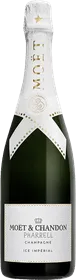
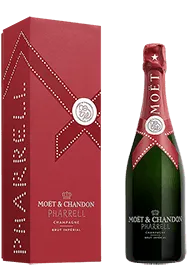
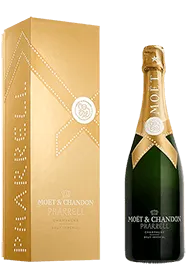
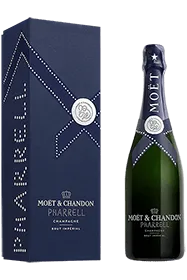
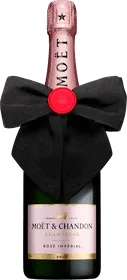
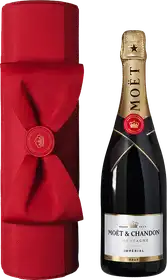
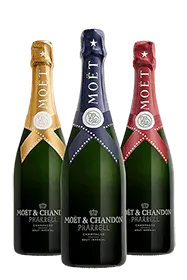
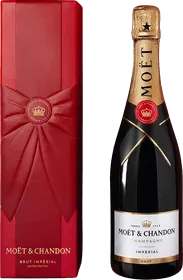
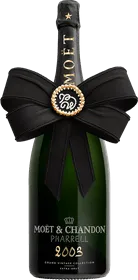
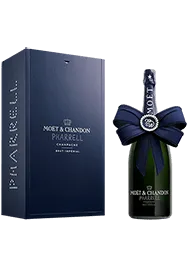
The 2025 collaboration with Pharrell Williams first dressed the Brut Impérial in a coloured collar scattered with white pearls; the summer 2026 edition presents the Ice Impérial, for the first time, without its white sleeve. The year-end Nœud and Étui editions, for their part, play on the house's black bow tie. Among champagne gift boxes, the choice therefore rests on the object: the wine remains that of the original cuvée.
The 2003 vintage, the exception in the Pharrell series
Only one piece in the collaboration contains a vintage champagne: the Grand Vintage Collection Édition Limitée Bow Creation 2003. Benoît Gouez chose this vintage from the scorching summer because it corresponds to the year Pharrell Williams turned thirty. The embroidered bow that adorns it detaches and can be worn as a brooch.