Assistant



 Guaranteed provenanceDirect from the estates
 DeliveryFree standard delivery from £ 250 purchase
 Secure PaymentVisa, American Express, Mastercard...
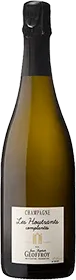
Geoffroy : Volupté Premier Cru Extra Brut Blanc de Blancs 2017
In-Stock
Let's talk about this product!
A pairing in mind? A question about the vintage? Comparison with another product? Find the answers here...
Description
Tasting notes and serving suggestions for the Volupté Premier Cru Extra Brut Blanc de Blancs 2017 from Geoffroy
Tasting
Appearance
The wine shows a pale golden yellow hue with subtle green-yellow highlights.
Nose
The aromatic bouquet reveals fine complexity, with notes of white fruits (green apple, lemon, white peach) accompanied by aromas of fresh brioche and pastry. With aeration, nuances of candied citrus (orange peel, preserved lemon), toasted hazelnut, and a chalky mineral dimension characteristic of the terroir gradually emerge.
Palate
The attack stands out for its incisive precision and mineral definition. The structure is built on a fine backbone of acidity and minerality, giving the wine remarkable architectural clarity. Despite its dry profile, the texture is creamy, thanks to the finesse of the bubbles and extended aging on lees. The palate unfolds flavors of white fruits, candied citrus, and hazelnut, before finishing on a long, elegant finish where the chalky minerality lingers.
Food and wine pairing
This champagne is ideally enjoyed as an aperitif. It pairs perfectly with langoustines, line-caught sea bass, scallops, and other seafood. It also matches elegantly with aged Parmesan or goat cheese. For a bolder pairing, it enhances semi-cooked or pan-seared duck foie gras.
Serving and cellaring
The Volupté Premier Cru Extra Brut Blanc de Blancs 2017 is best enjoyed at a temperature between 8 and 10°C. Thanks to its balance between acidity, alcohol, and extract, this champagne has cellaring potential until around 2037 under good storage conditions.
A finely chiseled, mineral Blanc de Blancs champagne from the Cumières terroir
The estate
Champagne Geoffroy is a family-run House whose winegrowing roots date back to the 17th century in Cumières, in the Marne Valley. In the early 1950s, Roger Geoffroy and his wife Julienne decided to produce their own champagnes rather than sell their grapes to the great houses. In the 1970s, René Geoffroy made the strategic choice to stop selling grapes altogether and to focus exclusively on crafting estate champagnes. Today, Jean-Baptiste Geoffroy, representing the fifth generation, runs the 14-hectare estate spread across four villages (Cumières, Hautvillers, Damery, and Fleury-la-Rivière). He works alongside his daughter Sacha, trained with renowned winegrowers such as Giuseppe Rinaldi and Marie-Thérèse Chappaz, who embodies the next generation of this récoltant-manipulant House committed to the authentic expression of its terroir.
The vineyard
Volupté comes from two plots located in Cumières, classified Premier Cru in the Marne Valley in Champagne: "La Montagne" (southeast exposure) and "Les Tourne-Midi" (southwest exposure). These chardonnay vines, around thirty years old at harvest, are planted at 120 meters above sea level on steep slopes with remarkably shallow soils. The terroir is defined by a thin layer of topsoil resting directly on Campanian chalk, a white limestone rock that sometimes outcrops at the surface. These steep, due-south-facing slopes benefit from optimal sunlight and natural drainage, allowing roots to penetrate deep into the chalk and draw out minerality and complexity.
The vintage
The 2017 growing season in Champagne offered favorable conditions for chardonnay ripening. The growing cycle unfolded in an overall positive context, yielding grapes with a fine balance between maturity and freshness—essential characteristics for crafting a Blanc de Blancs built for aging.
Winemaking and aging
After hand-harvesting and rigorous sorting, the grapes for the Volupté Premier Cru Extra Brut Blanc de Blancs 2017 are pressed in a traditional Coquard press, allowing for gentle extraction. Only the "Tête de Cuvée" fraction, corresponding to the highest-quality first-run juice, is selected. Alcoholic fermentation takes place in enamel-lined concrete tanks or neutral oak barrels, without temperature control and using indigenous yeasts. Malolactic fermentation is deliberately blocked to preserve the wine’s tension, minerality, and freshness. After fermentation, the wine is aged on lees for several months in 300-liter demi-muids and small used oak barrels. The champagne then ages for 94 months (seven years) on slats in the family’s chalk cellars before disgorgement. The minimal dosage of 2 grams per liter respects the natural expression of the terroir and grape variety.
Grape variety
100% chardonnay.